Edmonton snow services
Edmonton snow removal
Edmonton winter maintenance
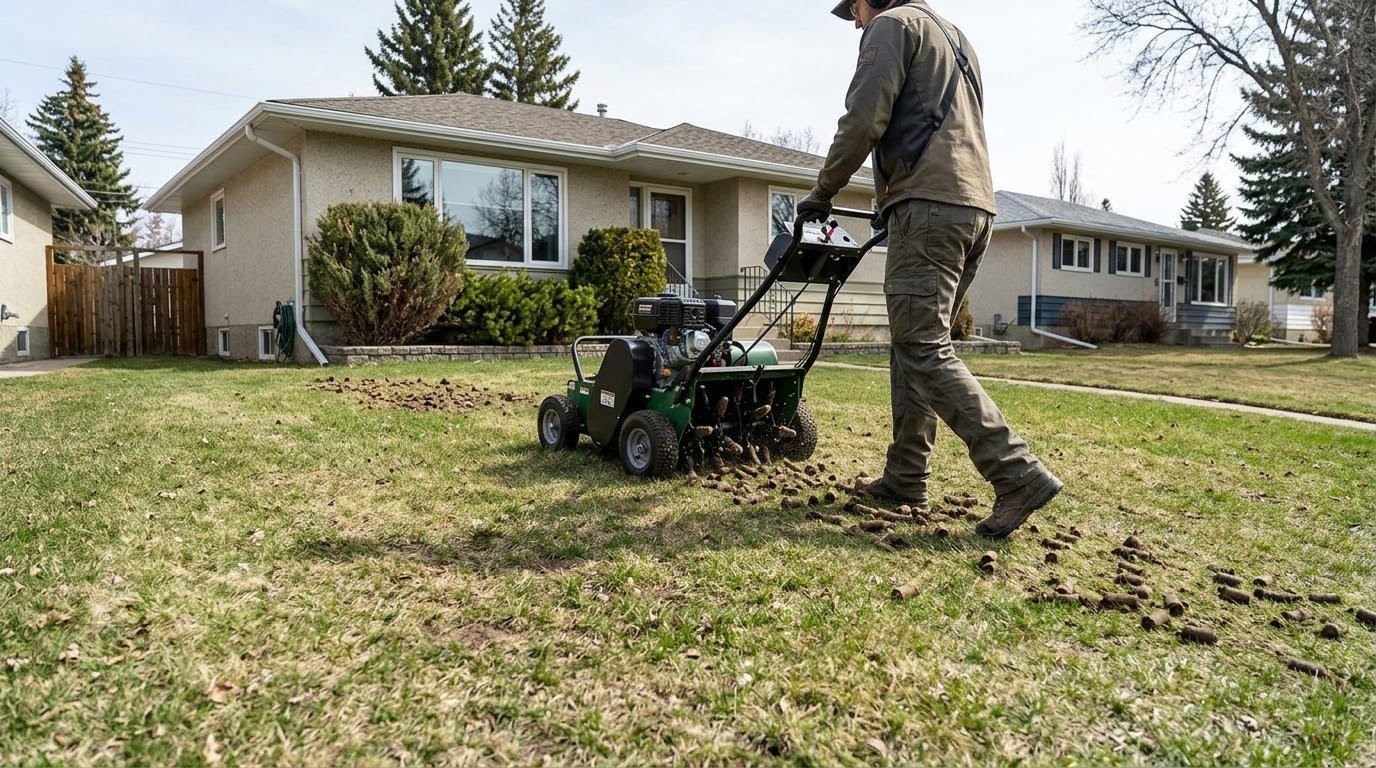

If your lawn is always the last one to green up, feels hard underfoot, puddles after rain, or stays thin no matter how much you water it, the real problem may be below the surface. In Edmonton, many lawns sit on clay-heavy rough grade, and local public guidance says rough grading commonly uses clay or an equivalent native material, with topsoil placed above it. That matters because clay-heavy lawns are more likely to stay tight, slow-draining, and prone to compaction.
The short version is simple: compaction is a physical soil-structure problem, so it needs a physical fix. Alberta’s own grounds manual recommends aeration for compacted soil, especially on clay soils, and recommends best practice is to core the lawn (removing small pieces of soil).
The City of Calgary and the University of Alberta describe lawn aeration the same way: removing small soil plugs or cores so air and water can reach the root zone.
Many homeowners assume their lawn is just naturally behind. That is usually too convenient an explanation. If your lawn is always thin, late, dry-looking, or weak in the same spots, there is often a structural reason. Edmonton’s sports field maintenance guidance states that Verti-Drain and core aeration correct soil compaction caused by increased use and traffic, which is a strong clue that compacted soil is a major turf problem in local conditions, not just on sports fields.
Long winters make that worse. Snow load, freeze-thaw cycles, slow spring drying, and normal foot traffic all work against a clay-heavy lawn. So if your yard always seems to lag behind the neighbour’s, it is not automatically “bad luck.” It may be a tighter, more compacted root zone.
-1.jpg?width=1376&height=768&name=unnamed%20(8)-1.jpg)
Soil compaction occurs when soil particles are pressed too tightly together. When that happens, the spaces between them shrink. The City of Calgary explains that compaction reduces pore space and the amount of air in the soil, while the University of Minnesota Extension says compacted soil has fewer large pores, reduced infiltration and drainage, and more resistance to root penetration.
For a homeowner, that translates into a lawn that cannot breathe, drink, or root properly. You can still water it. You can still fertilize it. But if the root zone is too tight, the lawn cannot respond the way it should.
Edmonton lawns are vulnerable for three reasons.
First, many start with a clay-heavy base. Local guidance on lot grading states that rough grading commonly uses clay or an equivalent native material. Second, clay soils are specifically identified in Alberta’s grounds manual as priority candidates for aeration when compacted. Third, Edmonton’s long winter and wet spring conditions make already-tight soils even harder to manage well.
Then normal life does the rest. Walking patterns, kids, pets, mowing on damp ground, and construction disturbance all add up. Over time, the lawn stops acting like a healthy sponge and becomes a sealed surface.
Compaction usually presents as a pattern, not a single dramatic symptom.
One of the easiest clues is the feel of the lawn itself. If the surface feels hard, tight, or almost sealed off, that is often a compaction signal.
If water sits on the surface, runs off too quickly, or struggles to soak in, that points to reduced infiltration. Calgary’s aeration guidance and the University of Minnesota’s soil compaction guidance both support that connection.
Edmonton’s sports field maintenance page directly ties compaction correction to areas affected by use and traffic. If your lawn always thins near walkways, gates, play zones, or backyard paths, compacted soil should be high on the suspect list.
If your lawn is always late to wake up, especially compared with nearby lawns, that can be a clue that the soil underneath is colder, tighter, and slower to function properly.
Compacted lawns often dry out faster than homeowners expect, not because they hold no water, but because shallow roots and poor structure make the lawn less resilient.
-1.jpg?width=1376&height=768&name=unnamed%20(9)-1.jpg)
Compaction does not usually fix itself. It usually compounds itself.
The soil stays tight. Water movement stays poor. Roots stay shallower than they should. That means the lawn becomes less efficient at using water and nutrients, less resilient in heat, and slower to recover after stress. University of Minnesota Extension is clear that compaction reduces infiltration, slows drainage, and makes root penetration harder.
That is why some lawns seem stuck in the same cycle every year. They are not just underperforming on the surface. They are underperforming because the soil environment is working against them.
-1.jpg?width=1376&height=768&name=unnamed%20(11)-1.jpg)
Some weeds are not random. They are clues.
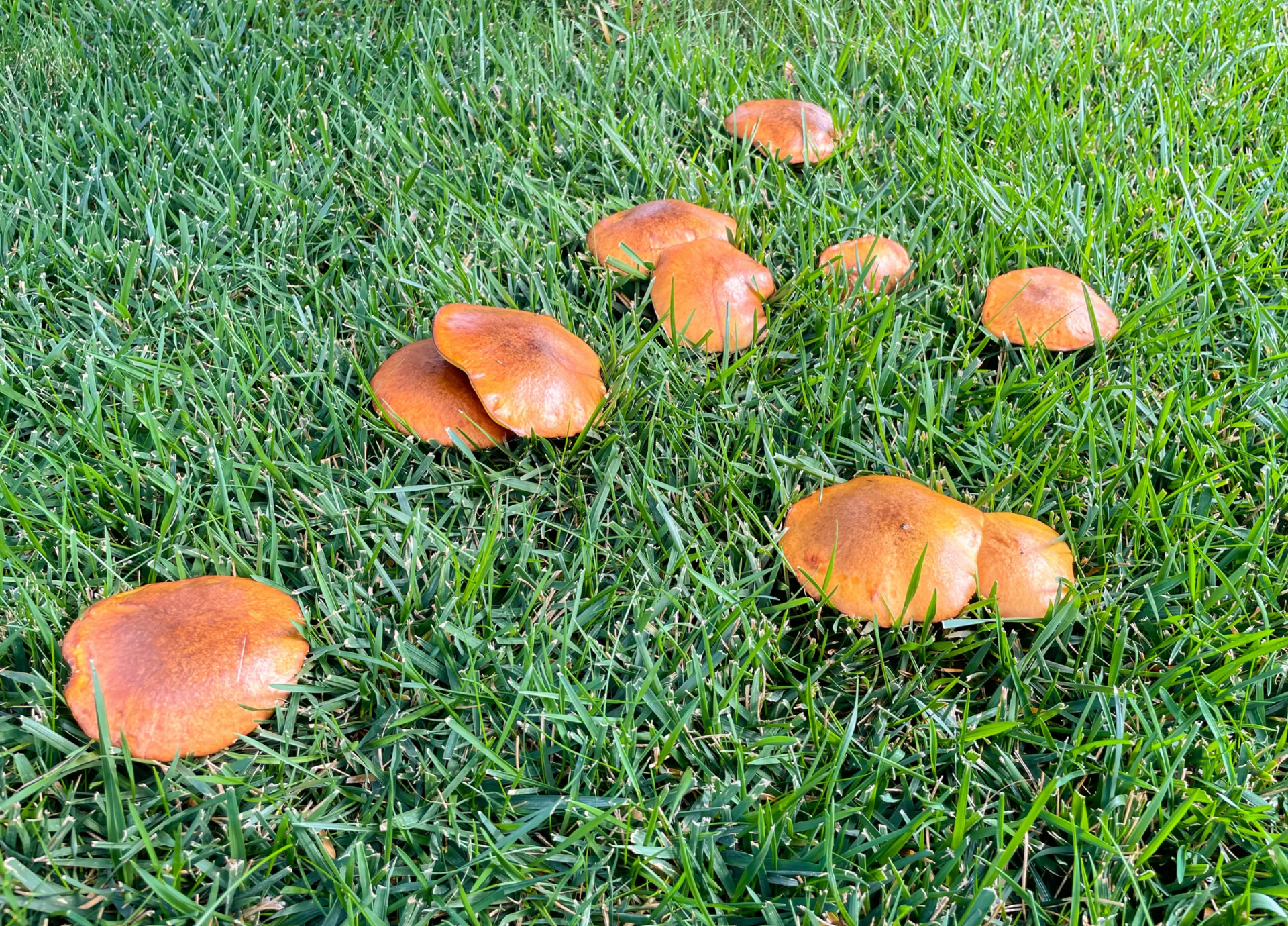
Penn State’s turf guidance says prostrate knotweed is especially adapted to compacted, heavily trafficked areas. Penn State’s indicator-weed material also links weeds such as plantain, dandelion, chickweed, mouse-ear chickweed, and prostrate spurge with compacted or heavy soils. That does not mean that every weed confirms a diagnosis on its own. But if the same weeds keep showing up in the same hard, worn-out, thin areas, they are often telling you something about the soil.
This is where many homeowners waste money. They keep treating the symptom above ground while the actual problem stays untouched below ground.
When you loosen compacted soil, you are not just poking holes for the sake of it. You are restoring function.
Alberta’s grounds manual says aeration loosens and adds air to the soil, making it more porous and allowing air, moisture, and fertilizer to reach the root zone. The City of Edmonton’s sports field guidance reinforces that by treating Verti-Drain and core aeration as compaction-correction practices, not cosmetic extras.
For a homeowner, the benefits are practical:
That is why loosening the soil can change a lawn more meaningfully than just watering more often or feeding it harder.
This is where the market gets muddy.
This is the standard. It physically removes soil plugs from the lawn. Alberta says aeration is best accomplished by coring the lawn. Calgary defines lawn aeration as the removal of small soil plugs or cores. The University of Alberta describes it as pulling out tiny cores of turf. That consistency across Canadian educational sources matters.
Rotary core machines are legitimate if they are true hollow-tine core machines. Alberta’s manual says circular-motion units are more efficient at covering ground, though they do not penetrate as deeply as vertical-motion units.
This is also true of deep-core aeration, and Alberta’s grounds manual explicitly says vertical-motion units penetrate deeper than circular-motion units. That makes reciprocating aeration especially compelling on tighter, heavier lawns where depth matters.
This is where a lot of marketing gets ahead of reality.
If a company claims liquid aeration is an equivalent replacement for deep-core aeration, that claim deserves scrutiny. Local Canadian educational sources define aeration as core removal, not as spraying a liquid substitute. A recent peer-reviewed Agronomy Journal study even compared liquid aeration with hollow-tine cultivation as distinct treatments, further reinforcing the point that they are not the same thing.
That does not mean a liquid product can never be used in a broader turf program. It means it is not the same thing as true deep-core aeration for meaningful compaction relief.
Spike-style tools may puncture the surface, but they do not remove soil cores. If the problem is real compaction, that is a much weaker approach than actual coring.
For meaningful lawn compaction, the best answer is straightforward:
True deep-core aeration is the only real fix.
That conclusion is not just opinion. Alberta says aeration is best accomplished by coring. Calgary defines it as removing plugs or cores. The University of Alberta describes the same plug-removal process. The city of Edmonton itself uses Verti-Drain and core aeration to correct soil compaction caused by foot traffic.
And the peer-reviewed side supports it too. A study published in Agronomy Journal found that increasing the amount and frequency of core aerification improved soil physical properties, including lower bulk density and lower surface hardness, showing that real core aerification can measurably reduce compaction and improve the soil environment.
So the hierarchy is simple:
This is one of the few places where the premium can be defended technically, not just cosmetically.
Alberta’s own grounds manual says vertical-motion units penetrate deeper than circular-motion units. That means a modern reciprocating aerator can offer a real advantage on tougher, tighter, more compacted lawns where penetration depth matters.
For Edmonton homeowners with heavy, traffic-worn, slow-recovering lawns, deeper true core penetration is not a gimmick. It is often exactly what the lawn needs.
Preparation matters more than homeowners think.
Yes, if the soil is very dry. Alberta’s manual says coring is best when soil moisture is adequate. That does not mean muddy. It means workable.
Moist enough that the machine can penetrate properly and remove good cores, but not saturated to the point where the lawn turns sloppy.
Sprinkler heads, shallow utility features, invisible edging, and anything else hidden near the surface.
Hoses, toys, moveable planters, patio clutter, and anything that would prevent thorough coverage.
Cores on the lawn are normal. They are evidence that real aeration happened. A lawn that looks perfectly clean immediately afterward can be a sign that the service was neither very aggressive nor very thorough.
Deep-core aeration is not magic on day one. It is a structural improvement.
To get more from it:
The value is not just in the holes. It is in what the holes let the lawn do afterward.
The honest version is that both spring and late summer or fall can be valid windows in broader turf guidance. Alberta’s manual says the best time to aerate is early spring or late summer, and the University of Alberta says spring or fall can both work.
But for Edmonton homeowners, spring is still the smartest annual priority.
Why? Because this is when the problem becomes obvious. After a long winter, clay-heavy lawns often start the season tight, slow, and stressed. Spring deep-core aeration gives the lawn a better root-zone environment for the growing season ahead. So while fall can still be useful, spring is the best annual reset for many Edmonton lawns.
Alberta’s grounds manual says core aeration is required once a year on heavily used lawn areas and every three to four years on other areas. That is a useful baseline.
For Edmonton homeowners dealing with clay-heavy soil, winter stress, and repeat compaction symptoms, the practical rule is simpler:
aerate every spring.
That is the open secret for a lawn that repeatedly behaves like a compacted lawn. It is preventative maintenance with a clear physical purpose.
Here is the homeowner benchmark.
For a standard lawn up to about 4,000 square feet, $115 to $150 is a fair range for true deep-core aeration. If the quote is below that, it is worth questioning the equipment, thoroughness, or experience behind the service. If the quote is much above that, it is worth questioning the value unless there is a clear reason.
Price alone is not the whole story. The better question is always: Are they removing real soil cores with legitimate equipment?
You should not expect overnight perfection. You should expect a better soil environment.
That means:
That is a more honest expectation, and it remains very strong.
If your Edmonton lawn is always the last to recover, always looks thinner than it should, or always seems to struggle in the same spots, stop assuming that is just how your lawn is.
It may be compacted.
And if it is compacted, the fix is not more water, more fertilizer, or better weed control. The fix is to physically open the soil.
For Edmonton homeowners, that means true deep-core aeration, ideally done each spring, with real core removal and real penetration. Because when the soil is the problem, the solution has to start below the surface.
If your lawn is always the last to recover, always feels tight underfoot, or never seems to thicken the way it should, it may be time to stop treating the symptoms and fix the soil itself. For many Edmonton lawns, deep-core aeration is the most effective way to relieve compaction, improve airflow and water movement in the root zone, and give the turf a better chance to recover properly through the season.
At Neighbourhood Heroes, we use modern reciprocating deep-core aeration to deliver real compaction relief for Edmonton homeowners dealing with heavy soil, winter stress, and weak spring recovery. If you want to give your lawn the strongest possible start this season, book your spring aeration early before the schedule fills up.