
weed control Edmonton
Edmonton

If your lawn feels hard underfoot, puddles after rain, stays thin no matter how much you water it, or seems to invite weeds into the same tired areas every year, there is a good chance soil compaction is part of the problem. In simple terms, soil compaction happens when soil particles are pressed too tightly together, reducing the air space that roots need and making it harder for water, oxygen, and nutrients to move through the soil. Alberta’s own grounds maintenance manual specifically recommends aeration where lawns are compacted, especially in clay soils and heavily used turf areas.
That matters a lot in Edmonton. Many local lawns are built over clay-heavy rough grade, and the City of Edmonton’s lot grading guidance explicitly says rough grading commonly uses clay or equivalent native material, with topsoil placed above it later. That is a big reason Edmonton lawns often struggle with tight, slow-draining, traffic-stressed conditions.
This guide is built to answer the questions that actually matter to homeowners:
Compaction is not just “hard soil.” It is a root-zone problem.
When soil becomes compacted, the spaces between particles shrink. That reduces infiltration, drainage, airflow, and root movement. University of Minnesota Extension explains that compaction reduces pore space, increases soil strength, and makes it harder for roots to penetrate the soil. Even though that is not an Alberta source, the principle is universal and aligns closely with Alberta’s own grounds guidance, which states that aeration loosens and adds air to the soil under turf, so moisture, air, and fertilizer can reach the root zone more effectively.
For homeowners, that translates into a lawn that struggles to use the care you are already giving it.
-1.jpg?width=1024&height=1024&name=unnamed%20(1)-1.jpg)
This is where local context matters.
Edmonton lawns are often built on or over heavier soils, and the City of Edmonton confirms that clay-based rough grading is common. Alberta Infrastructure’s grounds manual then goes a step further, specifically flagging clay soils as aeration candidates. That combination is a strong clue: many Edmonton lawns are naturally more vulnerable to compaction than homeowners realize.
Then winter makes it worse. A long Edmonton winter means months of snow load, freeze-thaw stress, and delayed spring drying. By the time spring arrives, the lawn often looks ready before the soil profile is actually functioning well. That is why compaction is such a recurring local problem.
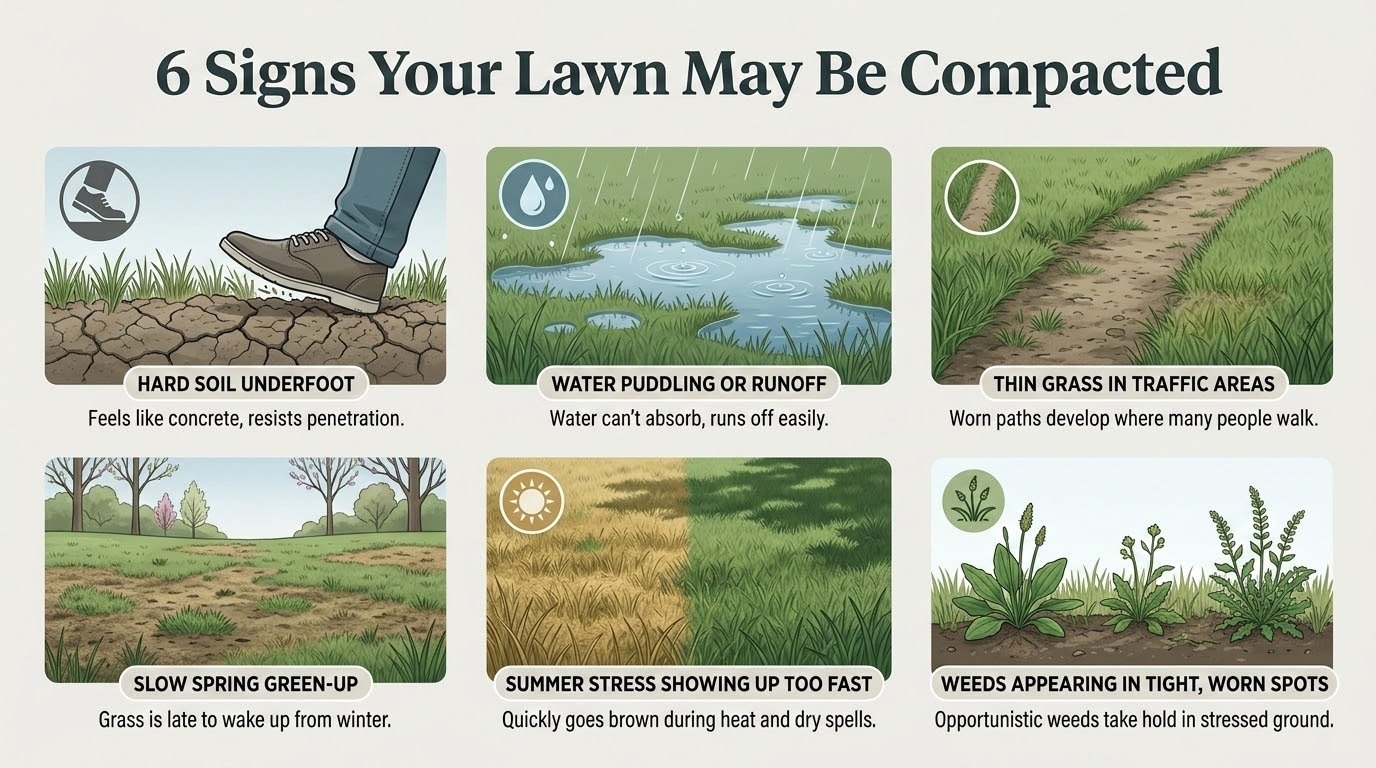
Compaction usually shows up as a pattern, not one dramatic symptom.
A compacted lawn often:
The City of Edmonton’s sports field maintenance page is useful here because it explicitly states that Verti-Drain and core aeration correct soil compaction caused by increased use and traffic. That same logic applies at the residential level. If your lawn keeps getting thinner in the same walked-on or hard-packed sections, compaction is a serious suspect.
Leaving a lawn compacted usually creates a downward spiral.
The lawn roots more shallowly. Water runs off instead of soaking in properly. Fertilizer becomes less effective. Recovery after winter slows down. Summer stress hits harder. The lawn opens up, and weaker turf gives weeds more opportunity to move in.
This is the part many homeowners miss. A compacted lawn is not just “a bit tight.” It is a lawn with a compromised root environment. That is why the problem tends to keep recurring until the soil is physically opened.
This is one of the strongest reasons not to ignore compaction.
Compacted lawns often create exactly the kind of environment that opportunistic weeds exploit. While weed infestations are never caused by a single factor, tight, stressed, thin turf is easier for weeds to invade than dense, vigorous grass. The City of Edmonton’s sports field maintenance guidance makes the basic point well: weed control is best done by growing good turf through aeration and irrigation (watering), with herbicides used only when needed.
That is the smarter sequence. Build better turf first. Do not just keep fighting symptoms on the surface.
Loosening compacted soil is about restoring function, not just creating visual holes.
Alberta Infrastructure says aeration loosens and adds air to the soil under turf, making it more porous and allowing air, moisture, and fertilizer to reach the root zone. The City of Edmonton’s sports field program reinforces the same concept by listing core aeration and Verti-Drain work as central compaction-correction practices.
For homeowners, the practical benefits are:
This is where many companies start playing word games.
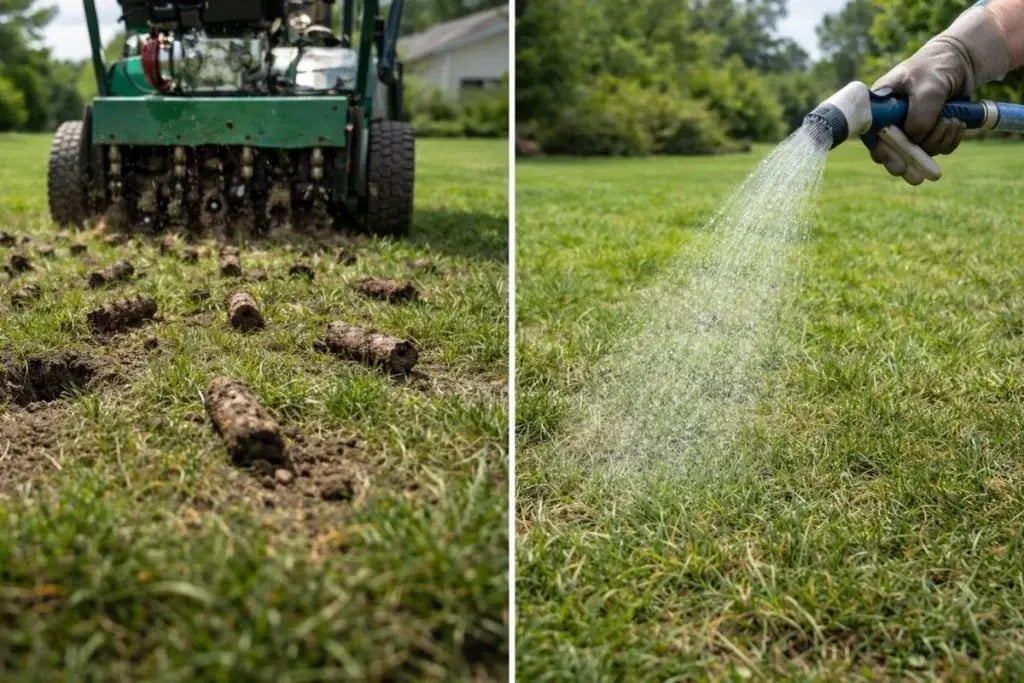
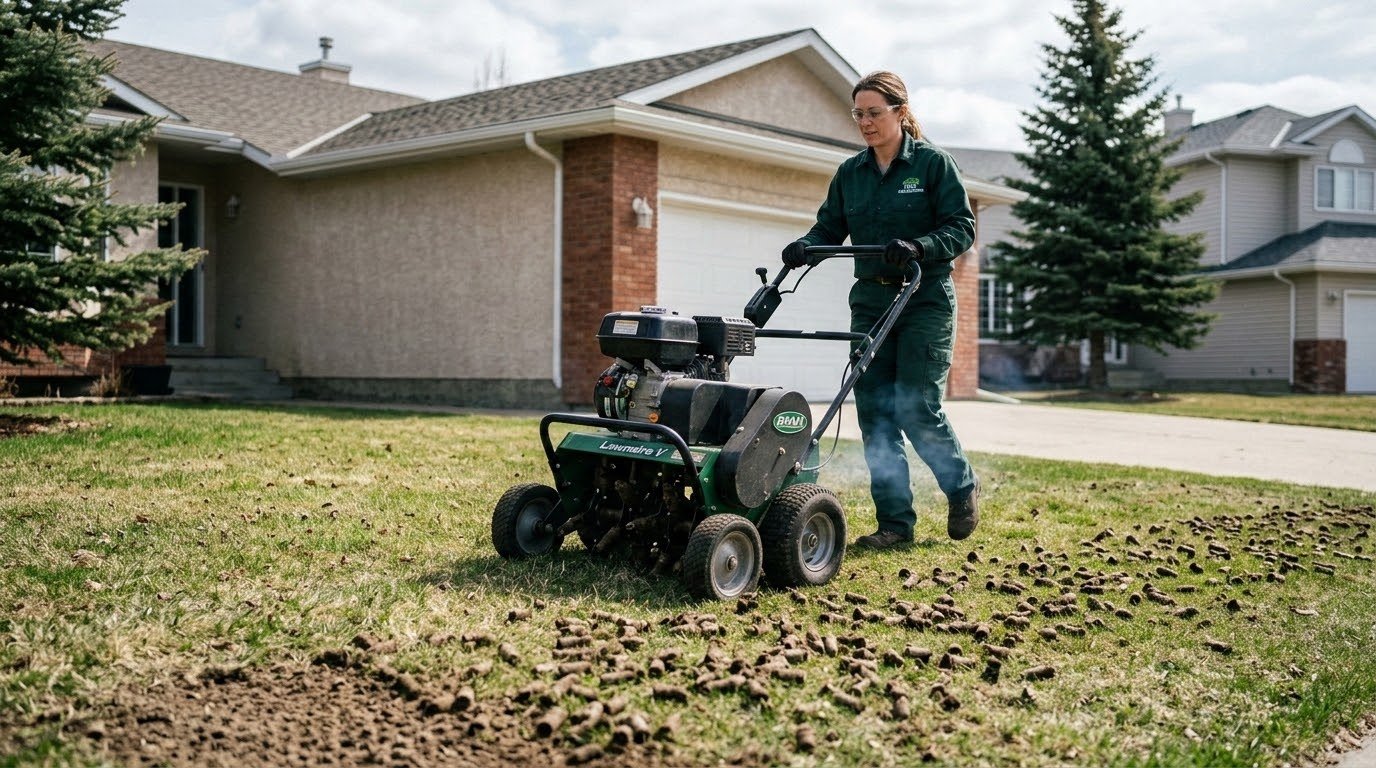
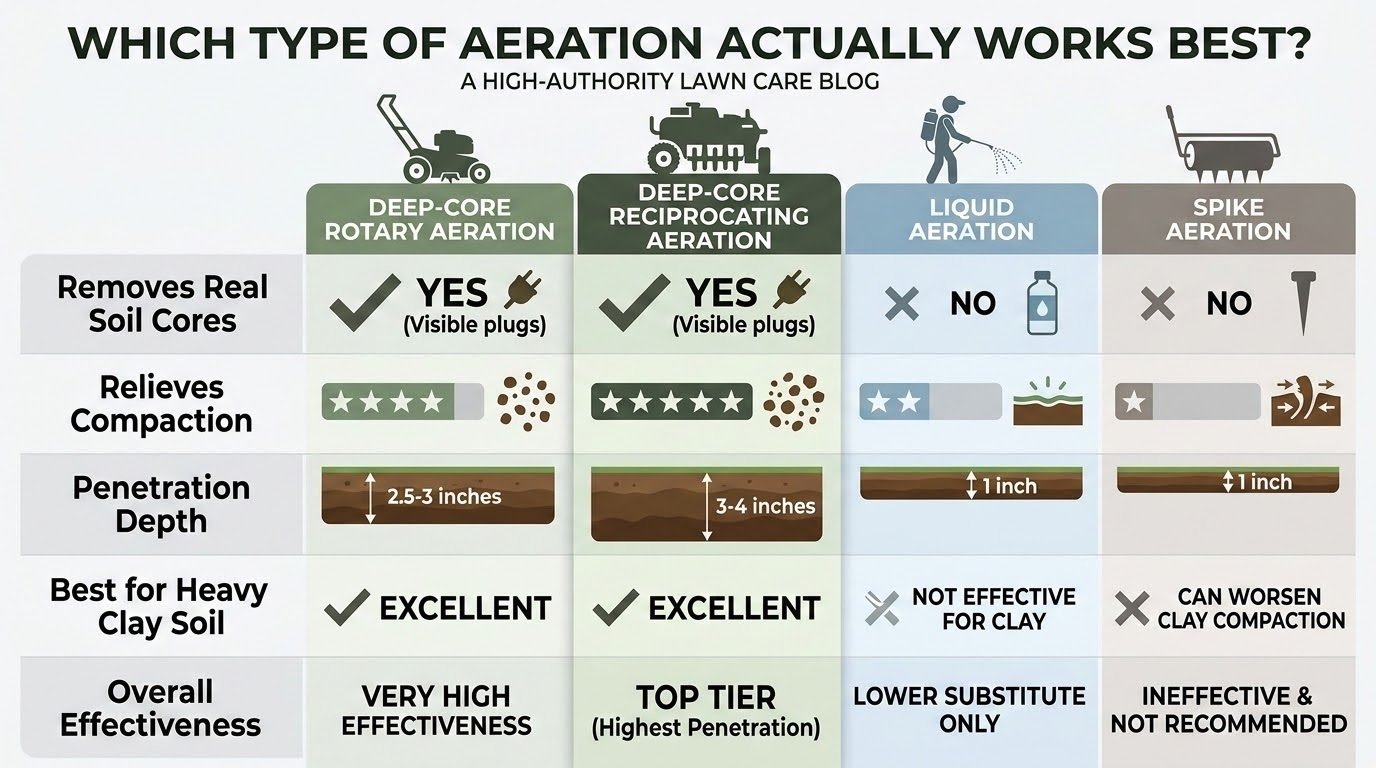
This is the gold standard. It physically removes soil plugs from the lawn to relieve compaction and create real channels for air, water, and nutrients. Alberta Infrastructure says aeration is best accomplished by coring the lawn. The University of Alberta’s Folio also describes aeration as removing small cores of turf to allow air and water into the roots.
If your goal is to actually fix compaction, deep-core aeration is the best service to prioritize.
Alberta’s grounds manual describes circular-motion core units as using hollow tines or open spoons mounted on a drum. It says they are more efficient at covering area, though they do not penetrate as deeply as vertical-motion units.
That makes rotary core aeration a solid modern option for many residential lawns, especially if the machine is properly set up and the soil is in the right moisture range.
Alberta’s manual also describes vertical-motion hollow-tine units and notes that circular-motion units do not penetrate as deeply.
That matters because deeper penetration can be especially valuable on tighter, more heavily compacted Edmonton lawns. So if the question is rotary or reciprocating, the honest answer is that both can be effective if they are true hollow-core systems, but reciprocating units may offer a depth advantage in tougher soils.
This is where the gloves should come off.
If a company is selling liquid aeration as a replacement for true core aeration, that is weak. Liquid products do not remove cores. They do not create the same physical relief channels in the soil. They do not do what true mechanical hollow-core aeration does. The Alberta and University of Alberta sources that actually discuss lawn aeration focus on coring, not on sprayed substitutes.
That does not mean liquid products can never be part of a broader soil-conditioning program. But if a lawn is genuinely compacted and a company is pitching liquid aeration as the equivalent of deep-core aeration, that is marketing first and mechanics second.
Spike-style tools create punctures, but they do not remove plugs. For real compaction relief, hollow-core coring is a far stronger option. If someone is paying for “aeration” and getting little more than spikes or surface disturbance, they should ask better questions.
For compacted Alberta lawns, the strongest answer is straightforward:
Deep-core aeration is the most effective overall method.
More specifically:
That position is the most defensible because Alberta’s own manual explicitly says aeration is best accomplished by coring, and the University of Alberta describes aeration in the same plug-removal terms.
Compacted lawns and thin lawns often show up together, and that is not a coincidence.
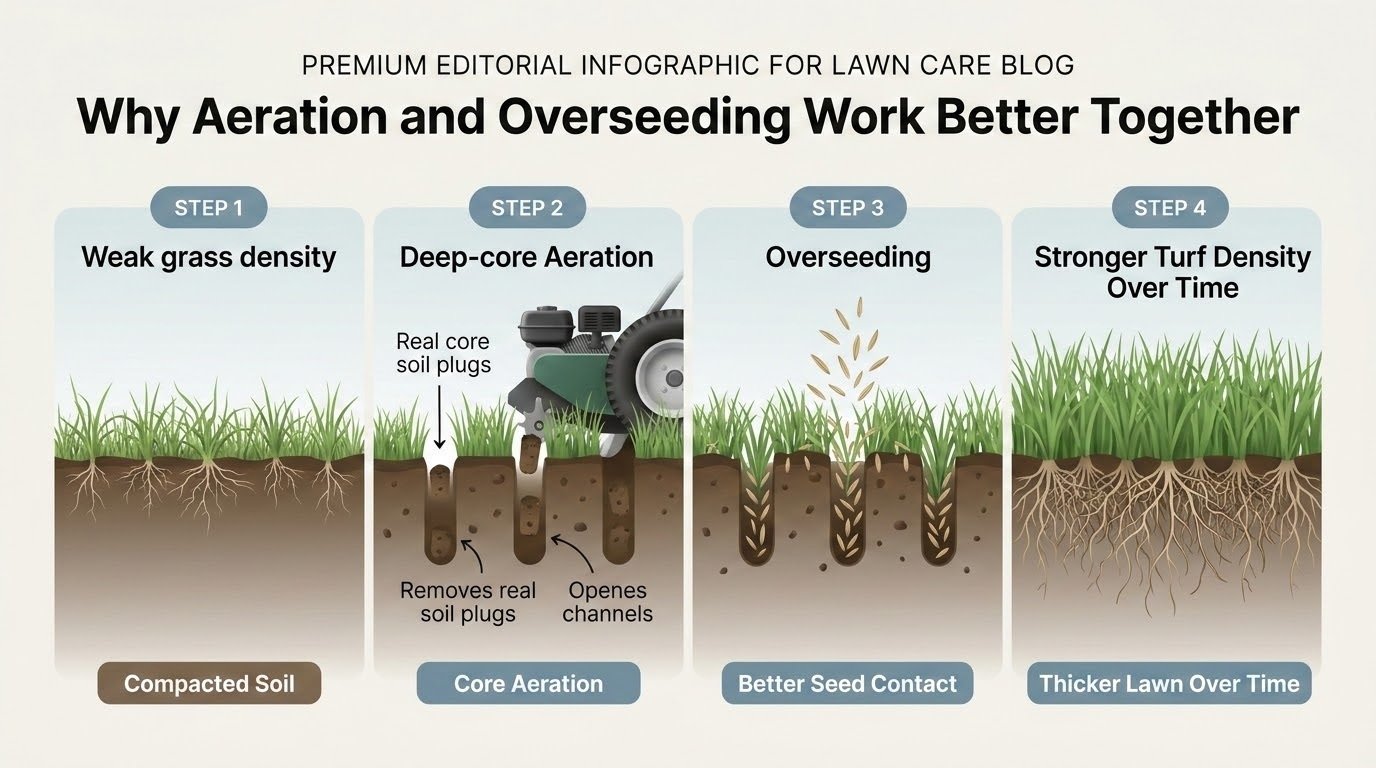
The City of Edmonton’s sports field maintenance program pairs aeration with top dressing and overseeding to restore damaged turf conditions. That is exactly the right logic for residential lawns, too.
Aeration improves the soil environment. Overseeding improves the turf density. Together, they address both the below-ground and above-ground problems.
That is why aeration plus overseeding is often the smartest move for an Alberta lawn that is thin, tight, and underperforming.
Here is the most honest version.
Alberta Infrastructure says the best time to aerate is early spring or late summer. The University of Alberta says aeration gives the lawn a good start in spring or fall. So no, the evidence does not justify pretending spring is the only acceptable window.
But for Edmonton homeowners, spring is still an exceptionally strong time to book deep-core aeration.
Why?
So while fall can be a good time too, our recommendation for Edmonton is simple: book deep-core aeration each spring. That is the most practical local habit for keeping compacted clay lawns healthier year after year.
Alberta’s manual says core aeration is required once a year on heavily used lawn areas and every three to four years on other areas. That is a useful baseline.
But for Edmonton homeowners dealing with:
Our recommendation is more aggressive:
aerate every spring.
That is not because every square foot of every lawn is equally bad. It is because Edmonton’s local conditions make spring compaction management one of the highest-value annual services a homeowner can book.
This part should also be handled honestly.
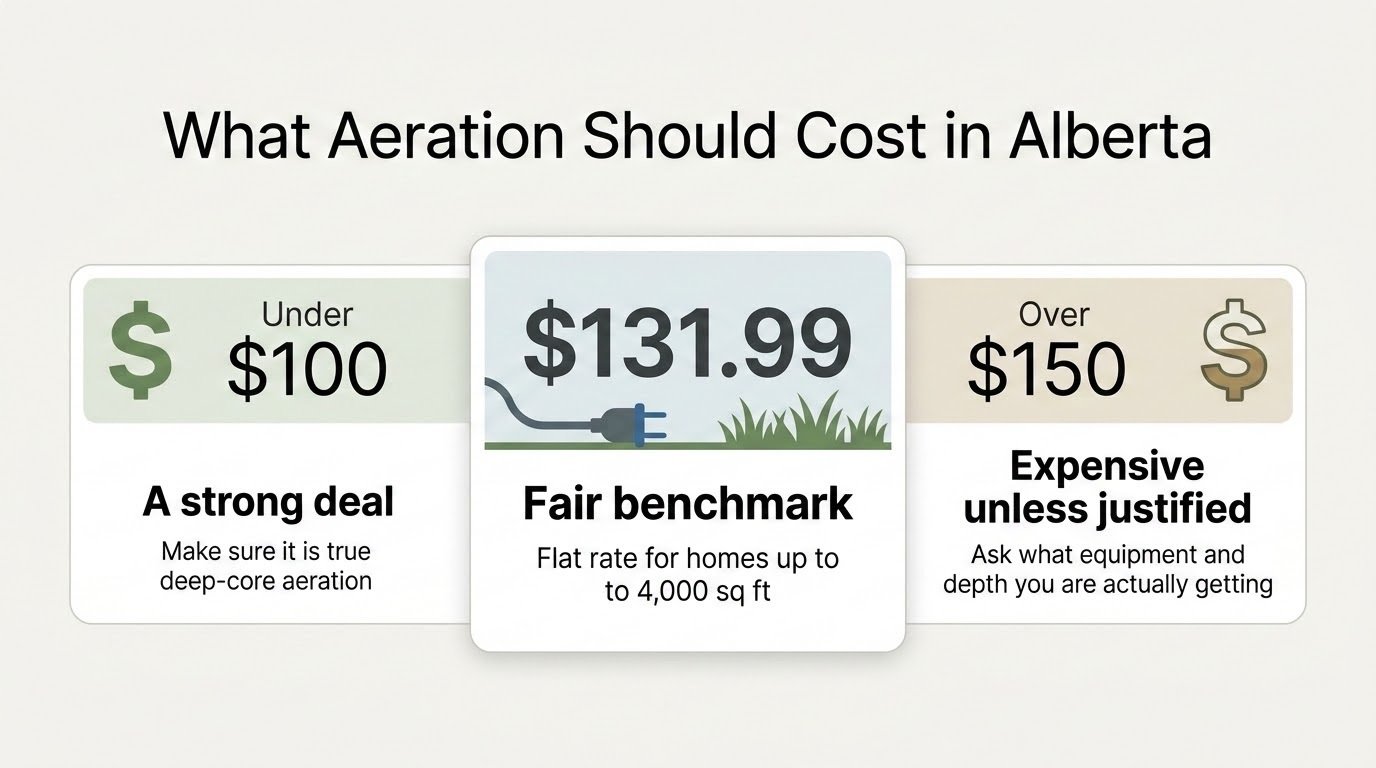
A fair benchmark for a standard residential lawn is our flat rate of $131.99 for homes up to 4,000 square feet.
Based on that:
So yes, in practical consumer terms, above $150 is usually pushing it, and below $100 is usually a steal. But the more important question is still this: are they removing real soil cores with proper equipment?
If not, then even a low price can be overpriced.
If your lawn is compacted, weak, or weed-prone, you are not just dealing with a cosmetic problem. You are dealing with a soil-structure problem.
For Alberta lawns, especially in Edmonton, the best solution is usually not vague “soil conditioners” or liquid aeration substitutes. It is true deep-core aeration, done with either a strong modern rotary machine or a reciprocating core aerator, followed by overseeding when the turf is thin. Alberta and Edmonton sources consistently support coring as the standard for relieving compaction and restoring turf function.
And because we live in Edmonton, with heavy winters and clay-heavy lawns, the simplest homeowner rule is this:
Book deep-core aeration every spring before your lawn spends another season fighting through tight, stressed soil.
If your lawn feels hard, drains poorly, or never seems to thicken properly, deep-core aeration is one of the smartest services you can book. Our flat-rate aeration is $131.99 for homes up to 4,000 square feet, and we recommend getting it done each spring so your Edmonton lawn starts the season with better airflow, better root-zone function, and a better chance to thrive.
Book an Aeration Today!