Edmonton snow services
Edmonton snow removal
Edmonton winter maintenance

Dandelions are not useless for pollinators. But they are not the best answer either.
That is the honest starting point for Edmonton homeowners. Pollinator Partnership’s Aspen Parkland guide says dandelions can provide nectar in early spring before other flowers open. So the idea that bees and other pollinators use dandelions is real. But that same guide is built around a better principle: pollinators need a variety of plants that provide nectar and pollen throughout the season, along with shelter and nesting support. In other words, dandelions may help a little, but they are not a real pollinator strategy.
That matters because much of the online conversation has drifted toward a shallow conclusion: if pollinators use dandelions, then the eco-friendly thing to do is let them spread across the lawn. That sounds compassionate, but it is weak ecology. University and extension sources note that dandelions do not offer particularly high-quality pollen compared with other early bloomers, and urban pollinator research keeps pointing in the same direction: floral diversity, bloom succession, and intentional habitat are far more valuable than one aggressive lawn weed.
So the better question is not whether dandelions help at all. The better question is this:
If you really care about pollinators in Edmonton, what should you plant instead?
Yes, bees and other pollinators do visit dandelions. That part is true.
But “visited by pollinators” is not the same thing as “best for pollinators.” The University of New Hampshire notes that dandelions do not provide particularly good-quality pollen compared with other early-flowering species. They are convenient, not optimal. Pollinator experts also emphasize that pollinators are active from early spring through fall, which means one flower in one short window is never enough.
That is the weakness in the “just leave the dandelions” mindset. It takes one real fact and stretches it too far. Pollinators do not need a yard built around convenience weeds. They need a yard with better nutrition, better timing, and more diversity.
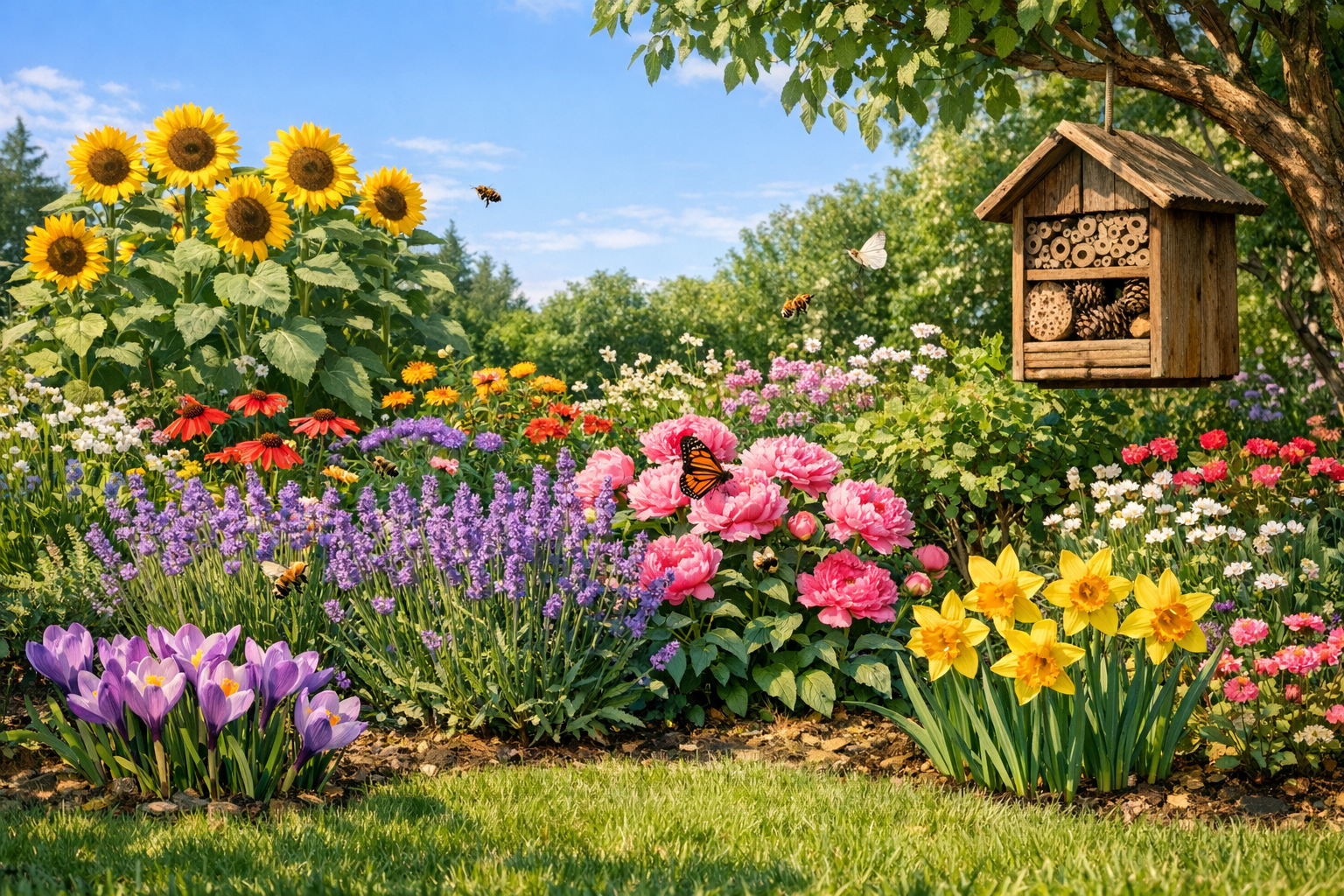
If you want to build a yard that genuinely helps pollinators, the goal is not just flowers. The goal is the right flowers at the right times, plus a habitat that actually fits Edmonton’s region.
Pollinator Partnership’s Canadian planting guides are tailored by ecoregion for exactly that reason. The Aspen Parkland guide, which applies to Edmonton, encourages people to include plants that provide nectar and pollen throughout the season and to think about habitat more broadly than just bloom colour. The University of Alberta gives similar advice: plant native or closely related plants, create a garden that blooms throughout the season, and include a diverse range of plants. Edmonton’s own natural-yard guidance reinforces that native plants provide food and shelter for pollinators and that natural yards should be carefully planned, designed, and maintained.
That means a strong pollinator yard should aim for:
That is a much higher standard than “yellow flowers showed up in my lawn.”
This is the part that gets romanticized online.
Letting dandelions spread through the lawn may feel environmentally friendly, but it is usually better for the weeds than it is for the pollinators. Edmonton’s own natural-yard guidance makes an important distinction here: a natural yard is not just a yard you stopped mowing or a lawn where weeds took over. It should be intentionally designed with habitat value in mind. Edmonton also warns that not every plant called “native” somewhere in Canada is appropriate for Edmonton’s ecozone, which is another reminder that ecology is about fit and planning, not sentiment.
There is another problem too. Dandelions are still aggressive weeds. Nature Alberta notes they were dropped from Alberta’s regulated list not because they became harmless, but because they were simply too widespread to enforce. The Alberta Native Plant Council also describes common dandelion as an introduced weed that reproduces aggressively. So no, “pollinators visit them” is not a complete ecological defence.
A responsibly managed lawn and a pollinator-friendly yard are not opposites. In fact, they work better together.
If you want to support pollinators in a meaningful way, plant a better system, not just one better flower.
The strongest approach is to think in terms of bloom season.
This is where dandelions get their reputation, because early spring forage really does matter. But there are better early options than hoping weeds fill the gap. Regional Alberta and Aspen Parkland resources point homeowners toward early-blooming native and adapted species, as well as flowering shrubs and trees, to support pollinators when the season is just getting started. Alberta beekeeper resources also highlight shrubs and trees such as willows as useful pollinator plants.
This is the easiest place to build real value into a yard. Mid-season flowering perennials can carry the bulk of summer forage if you choose a range of plant types. Alberta-based pollinator plant lists for the Aspen Parkland region include many native flowering plants observed to attract bees, butterflies, flies, beetles, moths, and other pollinators.
Late-season bloom is where weak pollinator yards often fail. A few spring flowers and one midsummer flush are not enough. Pollinator Partnership and Alberta Native Bee Council materials both emphasize the need for overlapping bloom times from early spring through fall. That is one reason a beautiful yard with a carefully chosen plant mix is stronger than a weedy lawn. It keeps feeding pollinators after the dandelions are long gone.
Local fit matters more than people think.
Edmonton’s native-plant guidance says a plant that is native elsewhere in Canada is not automatically the right ecological choice here. Some southern prairie species may not even be hardy enough for Edmonton. That is why region-specific resources are so valuable. If you want the best pollinator plants for Edmonton yards, use Edmonton and Aspen Parkland guidance first, then fill in with locally adapted plants where appropriate.
This is also where the article should challenge another lazy shortcut. A flower that pollinators visit is not automatically a good ecological plant. Alberta’s Himalayan balsam guidance is a useful reminder: pollinator visitation does not cancel out the broader ecological harm of a plant that displaces better vegetation and alters habitat quality.
The right question is not “Do pollinators ever use this?” The right question is “Does this plant improve the yard as pollinator habitat overall?”
You do not need to turn your whole yard into a meadow to do this well.
One of the most practical ideas from Edmonton and Alberta pollinator advocates is that homeowners can convert parts of a yard, not necessarily all of it, into a better habitat. A border, side bed, boulevard-adjacent strip, reduced-lawn corner, or dedicated pollinator bed can do far more ecological good than tolerating weeds through the turf. Alberta Native Bee Council resources and Edmonton natural-yard materials both support this kind of intentional habitat thinking.
That is the smarter trade:
That is better for the pollinators and better for the property.
This is the blunt version, but it is the right one.
If you care about pollinators, do more than tolerate dandelions. Plant:
That is what real pollinator support looks like.
Letting weeds take over is not a serious environmental plan. It is just the easiest possible substitute for one.
Dandelions are not worthless. Pollinators do use them, especially early in the season. But they are not the best answer for yards in Edmonton. The best answer is a yard designed with better plants, better timing, and better habitat value than a lawn full of weeds.
So yes, you can control dandelions with a lot less guilt than the internet sometimes suggests.
An environmentally friendly weed-control program helps manage unwanted weeds in the lawn. Intentionally designed pollinator habitat actually helps pollinators. Those two things are not in conflict. They are a smarter combination.
If you're looking for professional weed control help, you may be interested in one of our pre-built lawn care packages.